Showing posts with label design. Show all posts

Wednesday, May 2, 2012

Creature Couture

The ways in which big fashion names draw influence from the natural world are diverse and relentless. On Trend de la Creme the curator has made numerous keen eyed comparisons between a seasonal catwalk collection with certain branches of Kingdom Animalia. I selected some of the more striking or unusual similarities below but there are many more on the previously mentioned blog.

Alexander McQueen - Moth


Alexis Mabille - Parchment Worm


André Lima - Origami Penguin


Ding Yong - Cocoon


Jean Paul Gaultier - Cicada


Nicole Firetto - Bird


Oscar de la Renta - Octopus


Rodarte - Fighting Fish
Valentino - Jellyfish
Zac Posen - Moth

Thursday, October 13, 2011

Millinery

I'm now over a month into my Millinery Internship and I've learnt a huge amount already, not just specific techniques either as now I can actually sew and use an iron (ha!). The more complex processes I am now capable of include blocking materials such as Pinok pok, Sinamay and Buckram which is followed by drying, stiffening (glue like substance applied with a paint brush), ironing and then removing the hat from the block. With the basic form taking shape, I've then learnt to sew in wire to strengthen and a Petersham around the rough edge inside for aesthetic reasons which is accompanied by elastic. I've found it very enjoyable to learn these new skills though at times it can be rather tricky and sometimes painful, the tougher material of Buckram being the culprit for most of the pain!
Of course once the basic hat shape is complete it's time to add to it! I've learnt about a much wider scale of materials than I'd usually consider and how to attach them, such as spray mounting silk and sewing feathers. The use of feathers is my favourite, as you may be aware, so I'll find that knowledge particularly valuable as well as learning what else can look best on certain hats/colours. Headbands are something I've also started making which are relatively simple in comparison, so using these skills I designed and created my own for my flatmate's birthday at the beginning of the month with happy results all round! Also note the buffalo farm..
Here in the last photos is Sharon and I and after picking me up from my millinery we took a trip to Kingston to see 'Starglider', a Roy Brown exhibition about masks, sci-fi and human ritual. It was decided that night that I would write articles for online publication 5th Character of which Sharon is Editor in Chief and you can read my first three here: Starglider, Worlds of Wonder, D is for Donut. 
There will be much more to come considering the millinery and 5th Character but for now I decided to post a photo of how my hair.. I wish it would stay like the bottom photo more often. 
Images by KLV
.

Wednesday, July 13, 2011

Tuesday, July 12, 2011

Moon Baboon

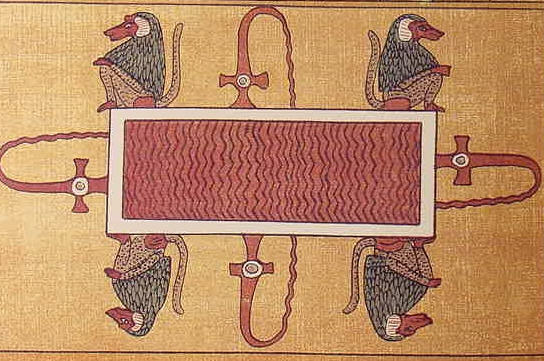
Baboons appear to be an ape highly connected to the moon from what my research suggests with accompanying mysterious yet aggressive attributes. In ancient Egypt, the baboon was apparently loyal to the lunar god Thoth with countless representations of this deity in baboon form, many in silver which also links back to the association with the satelitte. The potentially dangerous and aggressive creatures were also represented as ‘Hapi’ one of the four Canopic jar guardians and sons of Horus, Hapi protected the lungs. Further south in Africa, in Cote d’Ivoire, there is an abundance of baboon sculpture or 'Mbra'. "Baule Monkeys are powerful objects, which are forbidden to be seen in public display. Monkey figures share stylistic features with the mens´s sacred masks, and have some of the qualities of secrecy and danger to women. They combine animal and human traits in such way that it is nearly impossible to separate them, and they have the prominent teeth and boxy muzzle typical of the masks. Both also receive sacrificial offerings directly on the sculpture, and are associated with the bush. Mbra monkey figures, for example are kept in the village, but "fed" with sacrifices in the bush." - Susan Vogel. The last two images where Baule people have incorporated real baboon skulls have made them the most harrowing African sculptures I've seen!


In modern representation, there are still links to the lunar association the baboon once had as for example the illustration blog ‘Ape on the Moon’ at least has this vague connection. In artwork around the Internet I did see this connection arise in various areas.


Fashion baboon by Mattias Mackler and a French Deco lamp


 Metalized baboon skull on sale


'Rafiki: Baboon Of The Moon' - Kevin Tran


Saint Mandrill - Sam Chivers  (Though not a baboon this image still indicates the
link to religion and the moon)

Aardvarks and Armadillos

Though this post is very much delayed, thanks to locking myself out of my flat for two days(!!), I have decided to intertwine my research of animal symbolism into my blog and will post what I've found alphabetically to refer to in future projects.

Since the aardvark is such a wide spread creature, there is a degree of variation in the symbolism found for example the snout of an aardvark acted (perhaps still acts) as a phallic symbol in pre-colonial Africa, which according to ‘The Continuum encyclopedia of animal symbolism in art’ resulted in the creature having it removed by Tabwa (Congo) men in order to stop any embarrassment in front of the women. On an even more serious note, cutting Aardvark snouts and genitals is also intended to preserve and empower male superiority. However in Mali, the Bamana create masks and headdresses, named Chi Wara, intended for agricultural ceremonies and the aardvark as a symbol of agriculture and viewed as a ‘human animal’ for its digging behaviour is featured in the designs. By imitating animals such as aardvarks and pangolins, it is hoped that you will learn the secrets of the earth which in Bamana life is viewed as female. This ties in with the phallic snout of the aardvark as the act of cultivation is viewed as sexual by the Bamana and as their territory is in the dry central landscape of Mali, I would assume the aardvark is held in high regard. This animal reaches as far north as Egypt in traditional symbolism as the god Set is said by many to have the head and other qualities of an aardvark, acting as the god of deserts and darkness seems appropriate for this usually nocturnal creature.


Chi Wara general headdress (left), Chi Wara headdress with aardvark at the bottom (right)


Egyptian god 'Set'

From the continent of Africa to the Americas and the origin of the armadillo and much like the aardvark, the armadillo or Azotochtli (turtle-rabbit) is also synonymous with the earth and agriculture however this goes further with it also being associated with the afterlife. This is due to being a ground dwelling creature but also the nine bands of the nine banded (most populous) armadillos ’shell’ represent the levels of the underworld in Mesoamerica, evidence of this symbolism can be found in Mayan pottery. This link to the afterlife is furthered by the apparent grave digging service that was provided by armadillos in South American myth. For a creature that makes little noise, it was a surprise to learn it had such a connotation with music. In particular the Mayans depicted armadillos anthropomorphically as drummers, beating on jaguar skins and usually accompanied by other creatures. There is also the literal transformation of armadillos into musical instruments and as you can see by some of the images below there is a wide variety.


The modern depiction of the armadillo strays away from the musical and more towards the obvious aspect of its defence mechanism. From kitchenware to architecture, designers have mimicked the 'armor plating' of this creature.


Armadillo chair by Aodh O Donnell


1950s Maya style armadillo bracelet - Decotini


Lisa Maione - 'Architecture is to armadillo as'


Armadillo Shoes - Alexander McQueen


1940s Armadillo bag - Etsy